


Celebrate Saraswathi Puja to honor the goddess of knowledge and wisdom. Discover its rich rituals, deep spiritual significance, and vibrant traditions cherished across India. This auspicious festival celebrates learning, creativity, and intellectual growth, making it especially meaningful for students, teachers, artists, and scholars.
When Is Saraswathi Puja Celebrated? (Vasant Panchami & Key Dates)
Saraswathi Puja, also known as Vasant Panchami or Basant Panchami, is dedicated to Goddess Saraswathi—the divine embodiment of knowledge, wisdom, music, and arts. The festival is observed on the fifth day (Panchami) of the bright half of the Hindu lunar month of Magha, which usually falls in late January or early February.
In 2026, Saraswathi Puja will be celebrated on January 23, with the most auspicious puja muhurat from 7:13 AM to 12:33 PM. This time period is considered ideal for performing rituals, beginning educational activities, and seeking blessings for intellectual and creative pursuits. In 2025, Saraswathi Puja was observed around January 31, with universities and educational institutions across India organizing special pujas and cultural programs.
The festival marks the arrival of spring (Vasant Ritu), symbolizing renewal, growth, creativity, and the blossoming of knowledge. Educational institutions play a central role in the celebrations, emphasizing the importance of learning, wisdom, and artistic expression in society.
Historical Background of Saraswathi Puja
Saraswathi Puja, marking reverence to the goddess of knowledge, wisdom, and arts, is deeply rooted in ancient Indian traditions. The practice of worshipping Goddess Saraswathi dates back to Vedic times, where she was revered as a divine entity bestowing wisdom and learning. The Vedas reference Saraswathi initially as a river goddess, symbolizing purity, nourishment, and the continuous flow of wisdom.
Over centuries, her persona evolved, and she came to be worshipped as the goddess of knowledge, music, arts, and learning. In the epic Mahabharata and various Puranas, Saraswathi is portrayed as the daughter of Lord Brahma, the creator of the universe. She is often depicted seated gracefully on a white lotus, holding sacred scriptures and a veena—symbols of spiritual wisdom and artistic harmony.
Historically, Saraswathi Puja has been celebrated with great fervor in educational institutions and households of scholars and artists. The festival represents an important moment in the academic calendar, where devotees seek divine blessings for intellectual growth. Over time, this tradition has spread across regions, adapting to local customs while preserving its core spiritual essence.
Significance of Goddess Saraswathi
The significance of Goddess Saraswathi extends beyond academic learning. She embodies wisdom, eloquence, creativity, and enlightenment. Her name signifies “the one who gives essence (sara) to the self (swa),” highlighting her role in guiding individuals toward self-realization through knowledge.
Saraswathi is invoked at the beginning of educational journeys, artistic performances, and intellectual endeavors. Spiritually, she is regarded as the dispeller of ignorance, illuminating the path to truth and higher consciousness. Her association with the swan, which symbolizes discernment, represents the ability to distinguish between right and wrong, truth and illusion.
Artists, musicians, writers, and performers worship Saraswathi as their divine muse, seeking her blessings to enhance creativity and skill. This connection highlights the holistic nature of knowledge—balancing logic, morality, and creative expression.
Key Rituals and Practices During Saraswathi Puja
Saraswathi Puja involves a series of meaningful rituals that combine spirituality and cultural tradition. The day begins with devotees taking a ritual bath, symbolizing purification of body and mind. Homes and institutions are cleaned and decorated with yellow and white flowers, especially marigolds, considered auspicious.
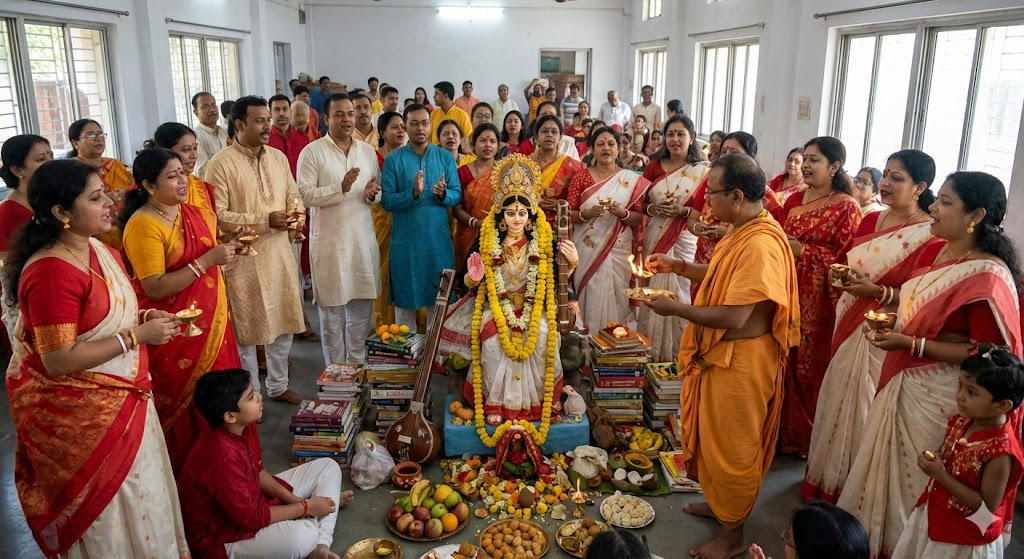
The idol or image of Goddess Saraswathi is placed on a clean white cloth. Devotees chant Vedic hymns and recite the Saraswathi Vandana, offering flowers, fruits, sweets, and incense. Books, pens, musical instruments, and tools of learning are placed before the goddess as a sign of surrender and devotion.
A unique ritual associated with Saraswathi Puja is Aksharabhyasam (Vidyarambham), where young children are introduced to writing their first letters. This sacred initiation symbolizes the beginning of a lifelong journey of learning under divine guidance.
Preparation for Saraswathi Puja: What You Need
Preparation for Saraswathi Puja requires careful attention to purity and symbolism. The puja area should be thoroughly cleaned and decorated with fresh yellow and white flowers. Essential items include:
- Idol or image of Goddess Saraswathi
- Clean white cloth and a raised platform
- Fruits (bananas, coconuts)
- Sweets like laddoo, kheer, or payasam
- Flowers, betel leaves, turmeric, kumkum, sandalwood paste
- Diya, incense sticks, and camphor
Books, notebooks, pens, and musical instruments are placed before the goddess, symbolizing devotion to learning and creativity.
Traditional Offerings and Prayers
Offerings during Saraswathi Puja hold deep symbolic meaning. Flowers represent purity, fruits symbolize prosperity, and sweets signify the joy and sweetness of knowledge. Devotees chant powerful mantras such as:
“Om Aim Saraswatyai Namah”
The aarti ritual plays a crucial role, symbolizing the removal of ignorance and the spread of divine wisdom. Devotional songs accompany the ritual, creating a spiritually uplifting atmosphere.
Celebrating Saraswathi Puja Across Different Regions
Saraswathi Puja is celebrated differently across India.
- In South India, it is part of Navaratri and Ayudha Puja.
- In West Bengal, Assam, and Odisha, it coincides with Vasant Panchami and is celebrated with grandeur in schools and colleges.
- In North India, devotees wear yellow attire and participate in community prayers and cultural events.
Despite regional variations, the core message of reverence for knowledge remains universal.
Cultural Impact of Saraswathi Puja on Society
Saraswathi Puja reinforces the importance of education, wisdom, and artistic excellence. Celebrations in educational institutions inspire students and teachers alike, fostering unity and lifelong learning. Artists and performers use the occasion to honor creativity as a vital force in cultural preservation and progress.
Tips for Hosting a Successful Saraswathi Puja
Choose a calm, clean space, prepare offerings in advance, and involve family or community members. Encourage traditional attire, conduct rituals with devotion, and conclude with prasad distribution. A well-organized puja nurtures both spiritual fulfillment and communal harmony.
Conclusion: Embracing Knowledge and Wisdom Through Saraswathi Puja
Saraswathi Puja is not merely a festival—it is a celebration of humanity’s quest for knowledge, creativity, and enlightenment. By honoring Goddess Saraswathi, we reaffirm the values of learning, wisdom, and artistic expression that shape personal and societal growth.
As we celebrate Saraswathi Puja, let us embrace these values in our lives, seek divine guidance in our pursuits, and strive for excellence in knowledge and creativity. By honoring Saraswathi, we honor the divine wisdom within ourselves.

