


Raksha Bandhan 2026 date: Friday, August 28, 2026. Every year, as the monsoon clouds settle over India and the fragrance of sweets fills the air, sisters tie a simple thread around their brothers’ wrists. On the surface, Raksha Bandhan looks like a family ritual — a thread, a tilak, a box of mithai, a promise of protection. But at Samarthguru Dhara, where we look at every tradition through the lens of Scientific Spirituality, we see the true meaning of Raksha Bandhan as something far deeper: a living lesson in energy, intention, and the invisible bonds that hold human relationships together.
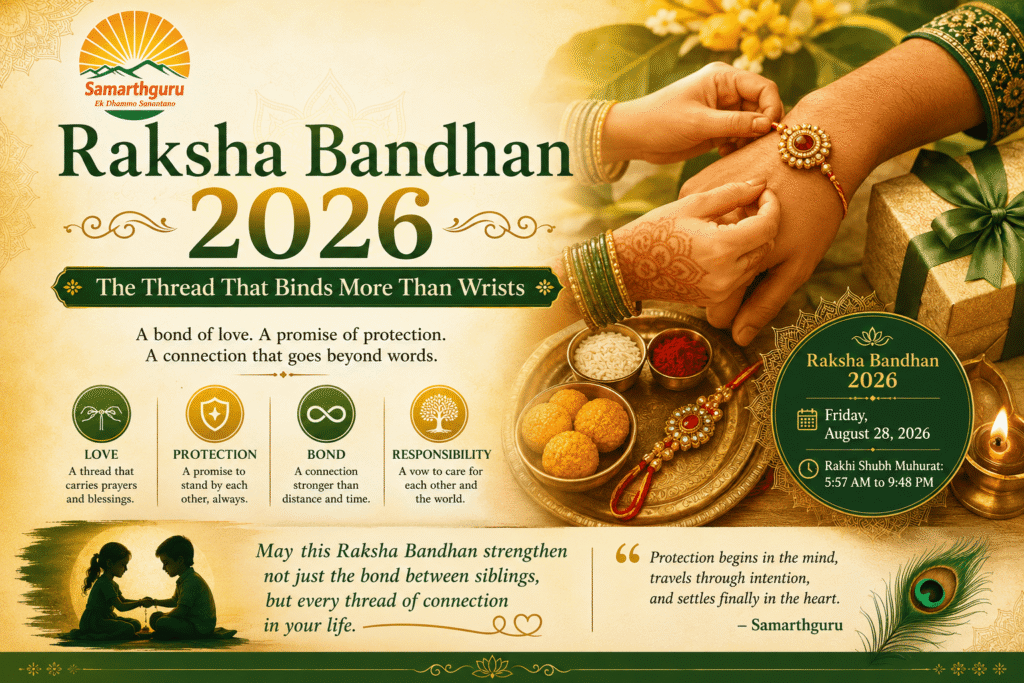
Raksha Bandhan 2026: Date, Day and Shubh Muhurat
Raksha Bandhan, also called Rakhi Purnima, falls on the full moon (Purnima) of the Hindu month of Shravana. This year’s key details:
- Date: Friday, August 28, 2026
- Purnima Tithi begins: 9:08 AM on August 27, 2026
- Rakhi Shubh Muhurat (auspicious thread-tying time): 5:57 AM to 9:48 PM, a window of roughly 3 hours 51 minutes on the main muhurat slot, with the Aparahna (afternoon) period traditionally considered most favourable
- Avoid: Tying rakhi during Bhadra kaal, which is considered inauspicious in most Hindu almanacs
Millions of households across India, Nepal, and the diaspora in the US, UK, and Canada mark this day, making it one of the most widely searched Hindu festivals online every August.
Every year the rakhi and gifting industry in India sees a significant seasonal spike, with online and offline retail of rakhis, sweets, and gifts running into thousands of crores of rupees in combined sales — a reminder of just how deeply this one thread of cotton or silk is woven into the country’s cultural and economic life.
What Does “Raksha Bandhan” Really Mean?
The word itself carries the answer. Raksha means protection, and Bandhan means a bond or a tie. Together, they describe a relationship of mutual responsibility — not one person protecting another out of obligation, but two people committing to look out for each other’s wellbeing. While the festival is most commonly celebrated between brothers and sisters, its true meaning is broader: it is about the sacred duty we hold toward anyone whose wellbeing we’ve bound ourselves to, in trust and love.
The Science Behind the Thread
We often ask: why a thread? Why not a gift, a letter, or a spoken promise?
In the science of energy and consciousness, a rakhi is more than decorative string. When tied with genuine intention, it becomes what we call an intention anchor — a physical object charged with the emotional and mental energy of the person who ties it. The wrist itself is significant; it sits close to the pulse points, where our body’s subtle energy channels are most active. A thread tied here, with focused thought and heartfelt prayer, is believed to carry that intention into the wearer’s energy field throughout the day.
This isn’t unlike what modern mind-body research increasingly recognizes: that ritual and intention, performed with focus and repetition, can measurably influence our mental state, our sense of safety, and our relationships. Raksha Bandhan, in this light, is an ancient technology for anchoring positive intention — a practice our ancestors understood intuitively, long before science had the language to describe it.
Protection Is a Two-Way Current
A common misunderstanding is that Raksha Bandhan is only about the brother protecting the sister. But energy, like love, does not flow in one direction only. The sister who ties the thread is offering her prayers, her blessings, and her hope for her brother’s long life and strength. The brother who receives it accepts a responsibility — but he also receives her energy, her faith in him, and the strength that comes from being loved and believed in.
This is the essence of bandhan — a bond is never one-directional. It is a current that moves both ways, protecting both people, elevating both people. In our own spiritual practice, we often say that true protection begins not with physical strength but with the strength of a connected heart.
Beyond Blood: The Wider Circle of Raksha Bandhan
While the festival’s roots lie in the sibling relationship, its spirit extends further. Throughout history, rakhis have been tied between friends, communities, and even between people and the causes or nature they wish to protect — trees, rivers, and the earth herself have received rakhis as symbols of humanity’s vow to safeguard them.
This wider understanding aligns closely with what we teach at Samarthguru Dhara: that spirituality is not confined to temples or rituals performed once a year. It is a daily practice of extending our sense of responsibility — to our family, our community, and the world we live in. Raksha Bandhan reminds us that protection and love are not scarce resources to be rationed only among blood relatives. They can and should be extended outward.
Making Raksha Bandhan a Moment of Real Connection
This year, as you celebrate Raksha Bandhan, we invite you to go a little deeper than ritual:
- Set a real intention before tying the thread — not a routine gesture, but a genuine wish for the other person’s wellbeing.
- Sit in silence for a moment with your sibling or loved one before the ritual begins. Let the noise settle. Let the moment be felt, not just performed.
- Reflect on your own bonds — who protects you, and who do you protect? Gratitude toward these people is itself a spiritual practice.
- Extend the circle — consider tying a symbolic rakhi to a cause, a tree, or a commitment you wish to protect this year.
A Thread Worth More Than Its Weight
In the end, Raksha Bandhan endures across generations not because of the thread itself, but because of what it represents: that human beings are meant to be bound to one another — not by obligation, but by love freely given and responsibility willingly accepted.
At Samarthguru Dhara, we believe every festival carries within it a spiritual science waiting to be understood. Raksha Bandhan teaches us that protection begins in the mind, travels through intention, and settles finally in the heart — a truth as scientific as it is sacred.
May this Raksha Bandhan strengthen not just the bond between siblings, but every thread of connection in your life.
Frequently Asked Questions About Raksha Bandhan 2026
1. When is Raksha Bandhan in 2026?
Raksha Bandhan 2026 falls on Friday, August 28, 2026, the full moon (Purnima) day of the Hindu month of Shravana.
2. What is the Shubh Muhurat to tie Rakhi in 2026?
The main auspicious window runs from 5:57 AM to 9:48 PM, though the Aparahna (afternoon) period is traditionally considered the most favourable time. It’s best to avoid tying rakhi during Bhadra kaal.
3. What does Raksha Bandhan actually mean?
The word combines Raksha (protection) and Bandhan (bond), together meaning a “bond of protection” — a mutual promise of care and responsibility, most commonly celebrated between brothers and sisters.
4. Is Raksha Bandhan only for brothers and sisters?
No. While the sibling relationship is at the heart of the festival, rakhis are also tied between friends, communities, and even as symbolic vows to protect nature, reflecting a broader spirit of care and responsibility.
5. Why is a thread used instead of another symbol?
In the science of energy and consciousness, a thread tied at the wrist — close to the body’s pulse points — acts as an intention anchor, carrying the emotional and spiritual energy of the person who ties it throughout the day.
6. What is the spiritual significance of Raksha Bandhan according to Samarthguru Dhara?
We view Raksha Bandhan as a practical example of Scientific Spirituality: a ritual that channels focused intention into a physical object, strengthening real emotional and energetic bonds between people — not just a customary exchange of thread and gifts.

