


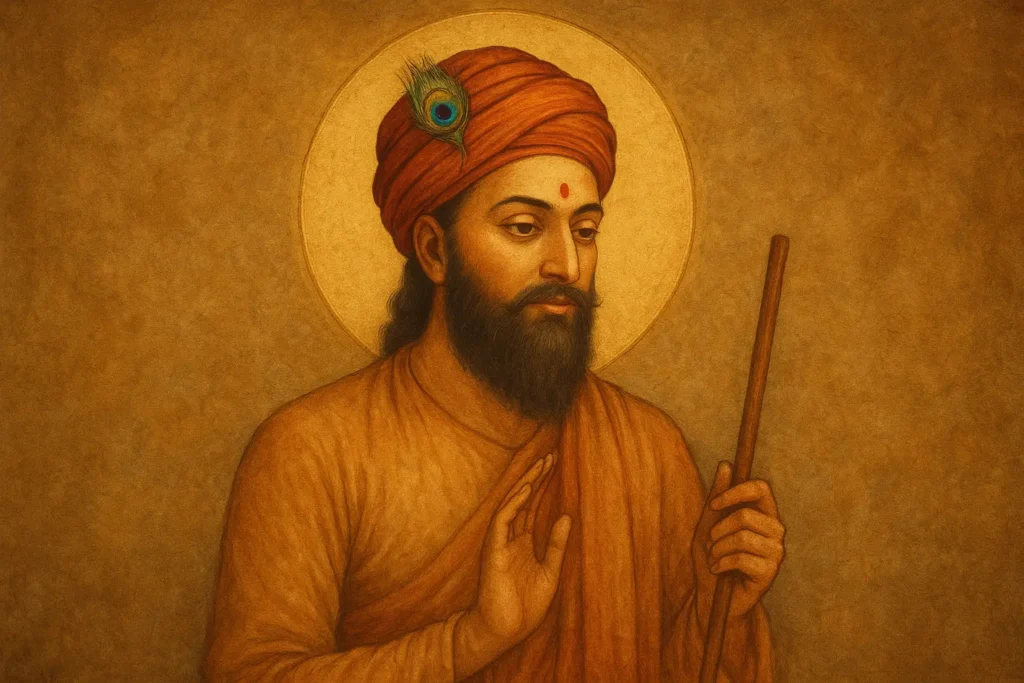
Rajab Sahib, a beloved disciple of Saint Dadu Dayal, was born around 1567 into a prominent Pathan clan in Sanganer, near Jaipur, Rajasthan. It is said that Rajab Sahib’s ancestors were originally Hindus. His father served as a Nayak (chief) for the Maharaja of Jaipur, a position he held in high esteem. Rajab Sahib’s childhood name was Rajab Ali Khan. In keeping with the environment and customs of the time, he first received training in exercise, wrestling, and weapon handling. Consequently, by his youth, he had a handsome and well-built figure. Rajab was not only handsome and well-built, but also possessed an impressive and attractive personality. Following this education, he also received training in reading and writing. It is said that Rajab Sahib enjoyed the company of saints and fakirs from childhood, and was eager to listen to religious discourses.
Meeting the Guru:
Sanganer is the birthplace of Rajab Sahib and from there
Forty-eight kilometers north lies the city of Amber. Discussions of Rajjab’s marriage began, and a match was arranged with a Pathan family in Amber. It is also said that Rajjab Sahib already knew the young woman and was deeply in love with her. The wedding procession departed from Sanganer and arrived in Amber. To reach the bride’s home, the procession had to pass by the place where the great saint Dadu Sahib had camped with his entourage near the foot of a hill. The procession moved forward with great enthusiasm, accompanied by music and dance. The groom, Rajjab, adorned with finery and a peacock feather on his forehead, rode a horse alongside the procession. Suddenly, he dismounted and went ahead to pay his respects to Saint Dadu Dayal Ji. Dadu Dayal Ji was engrossed in meditation at the time, so the groom Rajjab remained there for a while. What remained was that existence itself held him. When Dadu Sahib’s eyes opened, it was as if a lightning bolt had shone upon Rajjab’s body. By the time his head, bowed to greet him, had straightened, his heart had been transformed. Before he could say anything to Dadu Sahib, Dadu Sahib himself recited two couplets to him:
“I had done some work by doing the service and remembering the instrument.
Dadu forgot his worship, did not accomplish a single task. Rajjab did something amazing, tied a peacock feather on his head. I had come to worship Hari, but instead made hell my destination.”
These couplets weren’t just couplets; they were unerring arrows from the Guru’s quiver, piercing Rajjab’s heart forever. As these words pierced his heart, his heart began to detach from worldly desires. He bid farewell to the wedding party and family members and stayed there. His family tried to reason with him, but he refused. The bride’s parents also tried to convince him, “Don’t ruin your home, just get married.” Relatives tried to persuade him, but Rajjab didn’t budge. Rajjab left home like a restless river, his heart brimming with love for his beloved. A passion so intense it could shatter a rock in an instant. A love so profound that the entire world seemed nothing to him. Dadu Sahib was no less a connoisseur. He shot his words at the right time. His arrows were so powerful that they neither extinguished Rajjab’s love nor stopped the impulse, but only slightly changed its direction. The surge of love that had been directed towards his beloved turned towards Sadguru. The change in direction didn’t diminish its intensity; instead, it increased. That’s why he single-handedly crossed the precipice of logic and emotion from all his relatives. The devotion he felt for his beloved increased a thousandfold towards his Sadguru. Dadu Saheb accepted him as his disciple. Legend has it that Dadu Saheb had commanded him to always dress as a groom, and so he remained so throughout his life. Before becoming Dadu Saheb’s disciple, people called him “Rajjab Ali Khan.” Dadu Saheb first addressed him as “Rajjab Ji,” and since then, he has been known by the name Rajjab.
Guru Seva and Satsang:
It is said that while being initiated by the Guru Rajab Sahib was about 20 years old. This incident occurred around 1587. Once he met Dadu Sahib, he was there forever. It was as if two bodies had become one soul. Or rather, Rajab Sahib became Dadu Sahib’s shadow. Wherever Dadu Sahib went, he followed him He would become Rajjab Sahib. He would listen to every word of his Guru with great devotion. Nearly six years passed in this way, and then he began to give beautiful poetic form to his Guru’s discourse. Soon, Rajjab Sahib’s fame spread far and wide among devotees and saints, and he became Dadu Sahib’s most beloved disciple. Along with his own poetry, he also collected the poetry of his Sadguru.
At the time of Dadu Saheb’s death, Rajjab Saheb was in the same village, Narane. After his Sadguru’s departure, the world seemed so desolate to Rajjab Saheb that from then on, he often kept his eyes closed. He now saw the Guru’s physical form only in the formless form. Thus, he continued on his spiritual journey.
The meeting of Rajjab and Bashna Sahib is interesting and well-known. It is said that even after the Sadguru’s passing, Rajjab Sahib continued to live in Narane village. One day, Rajjab Sahib visited the home of his Guru brother, Bashna Sahib. Bashna Sahib was a householder and a devotee. Therefore, the husband and wife welcomed Rajjab Sahib with open arms. At that time, Rajjab Sahib was about 40 years old, yet despite his groom’s attire and unwavering devotion to his Guru, he looked as handsome as a young man. Along with his spiritual beauty, his physical beauty was also captivating. Seeing him in this groom’s attire, Bashna Sahib’s wife remarked, “This is Dadu’s disciple, who looks so magnificent, and you, who don’t even have enough food to eat.” Bashna ji was stunned, then said that all this disparity was the result of our guru’s grace. Hearing this, Rajab Sahib laughed. Then what kind of grace?
It so happened that within a few days, Bashna Sahib’s house also began to fill with food, wealth, and property. It is said that his wife never again had the opportunity to say such a thing.
Discipleship Tradition:
The main seat of Rajab Sahib’s discipleship tradition It is located in Sanganer and some monasteries are also established in the surrounding small villages. It is said that Rajab Sahib had 10 prominent disciples. His disciples and followers are known as “Rajab Panthi” or “Rajawabat.” Such saints and sages are found in many places. The most remarkable thing is that these people do not live bound by any set rules, but live freely.
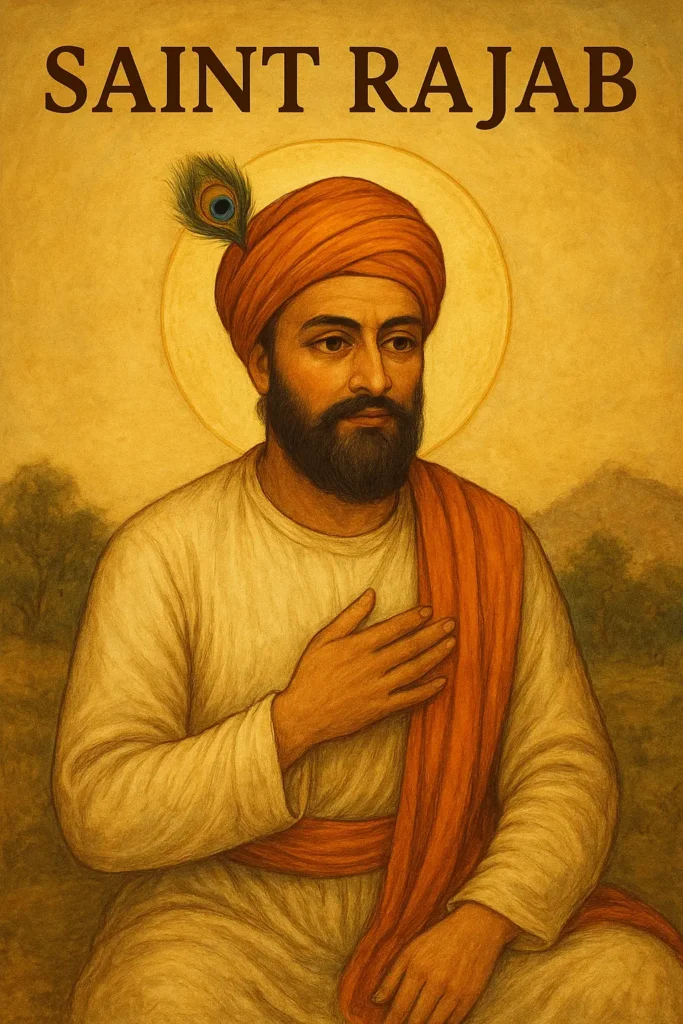
Works: Rajab Sahib was a highly regarded writer. Information is available about three of his works. The first is “Vani,” the second is “Sarvangi” or “Sarvagyoga,” and the third is “Angvadhu,” a collection of Dadu Sahib’s sayings, which Rajab Sahib set to verse.
It is popular that Rajab Saheb was in the last stages of his life.
He moved to the forest near Sanganer in 1689. It was there, at the age of 112, that he left his physical body and departed for the Supreme Abode. Rajab Sahib’s divine experience can still be felt in those forests today.
Courtesy:-
1. Saint Sudhasar-Viyogi Hari
2. Indian Saint Tradition-Baldev Vanshi
3. Saint Tradition of North India-Parshuram Chaturvedi
4. My mind is engrossed in the saints Osho 5. Saint Rajjab Wikipedia.

